Showing posts with label stir-fry. Show all posts

Wednesday, 21 September 2016

335) VENTIYE UPKARI

VENTIYÉ UPKARI
SIMPLE, ULTRA-DELICIOUS KONKANI TARO STEM STIR-FRY


Introduction:

          In my childhood, mother used to make this mouthwatering dish. No matter how much she made, it was never enough for all of us. It would just disappear in minutes! Ventiye upkari is so soft, it melts like butter in the mouth.

          Its sweet natural taste makes it impossible to stop once you spoon in the first mouthful. So easy to cook, it is a must be enjoyed dish, a plate you would crave to have every day!

Ingredients (for 2 servings):

     1)    Peeled vènti (the stem of the tender-most leaf of the taro plant (Colocasia Esculenta) / tarno alva dentu  or vènti in Konkani, palchèmbindé ilam thandu in Malayalam) – 500 gm. (see note)


     2)    Dry hot red chilies – 2 gm.
     3)    Coconut oil – 15 ml. (1 tablespoon)
     4)    Mustard seeds – ½ teaspoon
     5)    Salt – 5 gm.

To cook:

          Wash and drain the peeled venti. Chop the stems roughly to pieces of around 1 cm. (½ inch) size.

          Set a wide cast-iron wok on high heat. Pour in the coconut oil and throw in the mustard seeds. As soon as the mustard seeds are about to finish crackling, break each chili roughly to 2 or 3 pieces and drop them in. Stir once and chuck in the chopped venti. Tip in the salt, stir and cover with a cloche or lid.

A minute later, lift up the cloche and stir. Cover again and lower the heat. Stir occasionally and keep covered so that the steam melts the venti like butter. The taro stem pieces which had hitherto filled the wok are reduced to a fraction of the volume in 10 minutes’ time. Switch off the heat.

Your delicious ventiye upkari is now ready to serve. Enjoy this nectar-like treat hot as a side dish to rice or just slurp up a bowlful by itself!

Bon appétit!

Note:


          It is important that only the newest leaf stem is collected a little above where it joins the base. The tender leaf can be used to make delicious patrodo or umna patrodo. The stem can be peeled easily with a potato peeler. The tender stem cooks beautifully, is sweet and does not itch at all. The more mature stems are not used since they are fibrous and may itch in the mouth owing to the presence of calcium oxalate.

Saturday, 13 August 2016

316) KIRLA UPKARI

KIRLA UPKARI
MOST DELICIOUS KONKANI TENDER BAMBOO SIDE DISH


Ingredients:

     1)    Processed, finely chopped tender bamboo shoot (Kirlu in Konkani and Mulankoombe in Malayalam. For processing information, study my tender bamboo in Konkani cuisine article) – 350 gm.
     2)    Dry hot red chilies – 2 Nos.
     3)    Mustard seeds – ½ teaspoon
     4)    Coconut oil or other cooking oil – 1 tablespoon
     5)    Powdered salt – 5 gm. (1 teaspoon)

To cook:

          Rinse and drain the processed, finely chopped tender bamboo shoots. Break each red chili into two or three pieces and set aside. Set a cast-iron wok (for best taste) or pan on high heat. Pour in the coconut oil and tip in the mustard seeds. As soon as the mustard seeds are about to finish spluttering, throw in the red chilies.

          Stir once and tip in the chopped bamboo shoot. Add the salt and stir occasionally. Once it heats up nicely, turn down the heat and cover with a lid. Let the bamboo cook slowly for 10 minutes. Remember to stir once every few minutes to avoid burning at the base.

          Now remove the lid while still keeping it on low heat. Stir once every minute for 5 more minutes. Your ultra-delicious, crisp and hot kirla upkari is now ready to serve. Serve small portions as a side dish to rice.

Enjoy!!!

Note:


          Tender bamboo shoots have the ability to warm up one’s constitution the same way dry fruits do. So they are generally consumed mostly in the monsoon and in the winter months in moderate quantity despite their bewitching taste.

Monday, 4 July 2016

288) TAIKILYA UPKARI

TAIKILYA UPKARI
A TANTALIZING SIDE DISH OF CASSIA TORA AND JACKFRUIT SEEDS
Introduction:

          No bleak and gloomy, cold and windy monsoon season ever passes you by without ever compassionate mother nature silently working to cheer up her children. One such precious gift is the ubiquitous Cassia Tora or Senna Tora plant known as Taikilo in Konkani and Tavara or Takara in Malayalam (For more details, go to my Taikilya Bhojjo recipe). The heavenly taste of the tender leaves of this monsoon bush is brought out fully in this traditional Konkani stir-fry recipe. Be sure to cook and enjoy this one.

Ingredients:

     1)    Taikilo (tender or young leaves of Cassia Tora plant) – 500 gm.


     2)    Jackfruit seeds with outer skin removed – 350 gm.
     3)    Coconut – ½ of a small one
     4)    Dry hot red chilies – 3 Nos.
     5)    Mustard seeds – ¼ teaspoon
     6)    Coconut oil – 2½ tablespoons
     7)    Salt – 1 teaspoon
     8)    Water – 450 ml.

To cook:

Wash and drain the Taikilo leaves. Chop or shred to fine bits. Make sure that every bit of the thick nylon-like peel of the jackfruit seeds is removed. Chop the seeds to fine bits or cut into cubes of around 3 mm. (inch) size.

Break each chili into 2 or 3 pieces and set aside. Grate the coconut. Set a wide cast-iron wok on high heat. Pour in the coconut oil and throw in the mustard seeds. As soon as the mustard seeds are about to finish popping, tip in the broken chilies. Stir once and chuck in the chopped jackfruit seeds.

Pour in 250 ml of water. Stir and cover with a lid or cloche. Turn down the heat and let cook for 5 minutes. Now tip in the chopped leaves and the salt. Pour in the remaining 200 ml. of water. Turn up the heat and stir well. As soon as it starts boiling, turn down the heat and cover with the lid. Let cook slowly for 15 to 20 minutes while stirring occasionally.

The leaves need to cook fully. Now tip in the grated coconut and mix it in nicely. Turn up the heat and stir every now and then till all the excess water at the base has evaporated. Switch off the heat.

Your exquisitely delicious Taikilya Upkari is now ready to serve. Serve hot with steaming rice and curry.

Enjoy!!!

Notes:

     1)    If you have a sweet tooth, you can sprinkle a little sugar over the Taikilya Upkari and enjoy it by itself.

     2)    Try making Taikily Upkari with finely chopped cashew nuts in place of jackfruit seeds and let me know.

     3)    The finer the jackfruit seeds are chopped, the tastier the upkari.

     4)    The jackfruit seeds need to be fresh for best taste.

     5)    The cast-iron wok infuses soluble iron and lends the finest taste to the upkari.

Saturday, 2 July 2016

280) MANITAKKALI TORAN

MANITAKKALI TORAN
TASTY, NUTRITIOUS SOLANUM NIGRUM
STIR-FRY
Introduction:

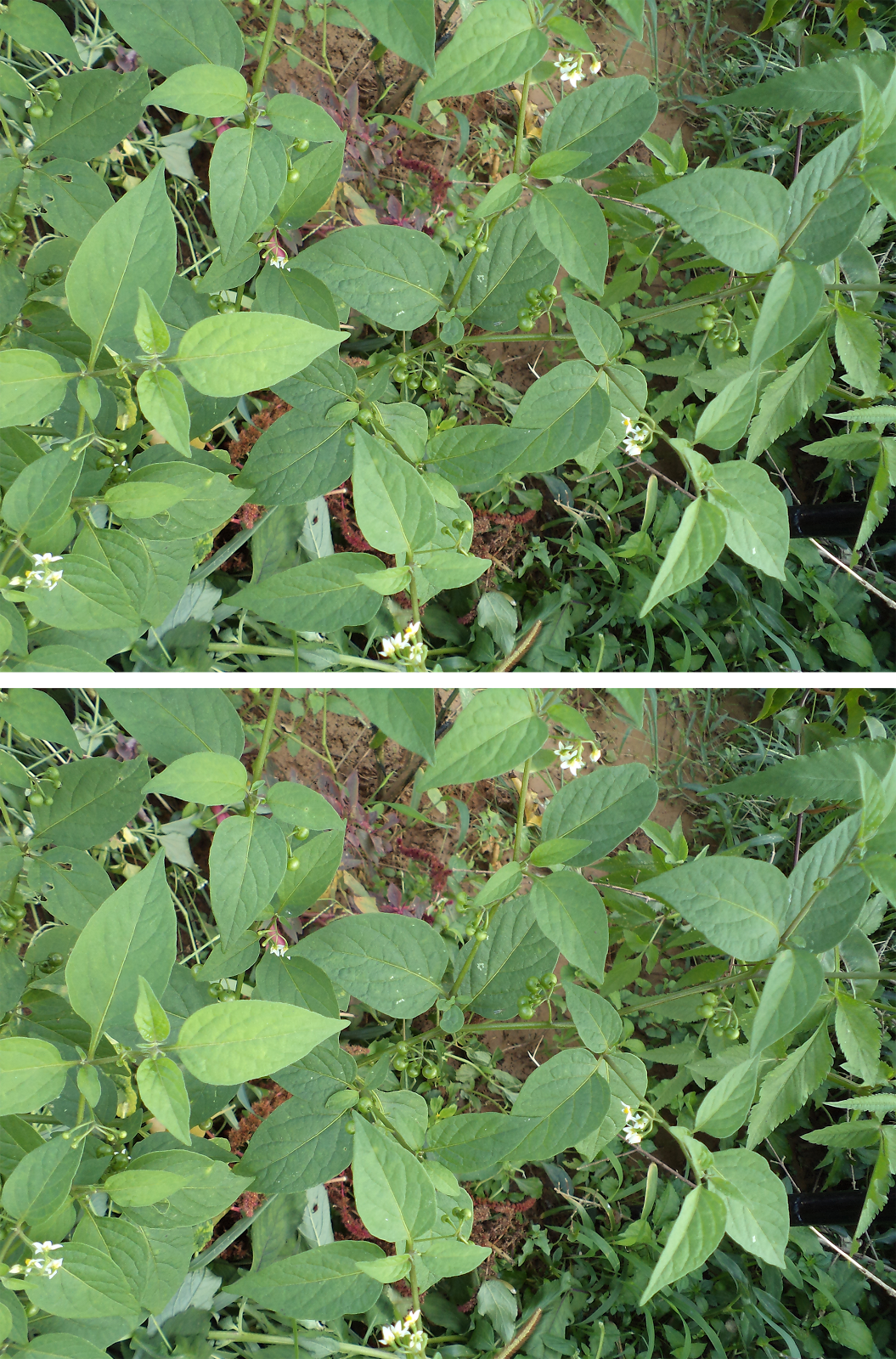
Solanum Nigrum, which is called Manitakkali in Malayalam, Manathakkali Keerai in Tamil and Kaachi Soppu in Kannada is a bushy herb that grows all over south india and in several places around the world. It requires no pesticide or other special care but loves regular watering and produces luscious green leaves in partial shade. In full sunlight, it produces more berries than leaves. Children love to pick the tiny ripe black berries which taste sourly bitter on plants growing in full shade, sour in plants growing in partial shade and very sweet on plants growing in full sunlight.

The local people of Wayanad pick the tender shoot tips holding two or three leaves each and prepare a delicious stir-fry as a side dish to rice. They believe that the leaves are highly nutritious and good for health and that they hold a natural cure for thyroid problems. These plants grow in the wild as well as in gardens and attract a large number of small lovebirds which gobble up the berries and propagate the seeds. The seeds germinate quickly in moist soil.

A good number of plants grow around our home and we love to watch the play of the birds. One of the birds wove a nest in a fig leaf on a plant in our nursery. Tiny chicks hatched out.
While harvesting the tender leaves or buds, take care to avoid the berries and the blooms, for they can turn your stir-fry bitter.

The local farmers say that one should not use a knife or a pair of scissors to collect the leaves, but should nip them with one’s nails or break them with one’s fingertips for contact with iron can turn the plant bitter. However, in my experience, it is the inclusion of the flowers and the berries that lends the bitterness. I prepare the stir-fry in a cast-iron wok as this endows the full taste to the toran.

Ingredients:

     1)    Tender Manitakkali (Solanum Nigrum) leaves or shoot tips with not more than 4 leaves – 200 gm.
     2)    Coconut – ½
     3)    Dry hot red chilies – 2 Nos.
     4)    Mustard seeds – ¼ teaspoon
     5)    Salt – ½ teaspoon
     6)    Coconut oil – 1 tablespoon

To Cook:

Wash and drain the leaves. Chop to fine bits and set aside. Grate the coconut and set aside. Break each dry red chili into 2 or 3 pieces.

          Set a cast-iron wok on high heat. Pour in the coconut oil and throw in the mustard seeds. As soon as the mustard seeds are about to finish crackling, tip in the dry chilies. Stir twice and chuck in the chopped Manitakkali leaves.

          Put in the salt and stir well. Cover with a cloche and lover the heat. Stir occasionally. As soon as the little water at the base of the wok evaporates (this will take less than 5 minutes), tip in the grated coconut and mix in thoroughly.

Switch off the heat and serve Manitakkali Toran hot n’ fresh with rice, with chappatis or with bread. The taste is so nice, even children who do not like spinach or amaranthus love to eat Manitakkali Toran.


Enjoy!!!

Wednesday, 7 August 2013

271) SURNA PHULLA UPKARI


SURNA PHULLA UPKARI
ELEPHANT FOOT YAM BLOOM STIR-FRY
A TASTY KONKANI RECIPE


Introduction:

In India, elephant foot yams (Chéna in Malayalam) are planted before the monsoon and dug up around 8 to 10 months later in summer when the plant foliage dries up. If however, you fail to harvest the yam or just leave it in the ground to grow further, the next season, it always brings forth a bloom long before the foliage shoot appears. This bloom is extraordinarily beautiful and you would feel reluctant to pluck it because of its bewitching beauty.


However, do not hesitate to pluck it before it opens fully; for once it opens, it gives out the foulest of odours like that of rotting flesh and is covered with hundreds of flies. The smell is so strong that your neighbours are likely to call the police. It would remind one of Rafflesia, the world's biggest and foulest smelling flower.

You can harvest this bloom any time before it blossoms or immediately after it opens in the morning. Never wait till late afternoon or you will have to pinch your nose and bury the flower. Yet before the smelling process starts, the bloom has no odour whatsoever. But for the dry outer sheath, every portion of the bloom when well-cooked is edible and unbelievably tasty. Every part of the bloom has got its own unique taste. The stir-fry is quite fragrant too.

I'm sure you will love it and enjoy it as much as my family does.

Ingredients:

     1)    Elephant foot yam blooms – 2 Nos.
     2)    Dry hot red chilies – 4 Nos.
     3)    Coconut oil (for best taste) or any other cooking oil – 1½ tablespoons
     4)    Mustard seeds – ¼ teaspoons
     5)    Powdered salt – ¾ teaspoons
     6)    Water – 150 ml.


To Cook:

Wash the bloom and chop it finely. Break each dry red chili into 2 or 3 pieces and set aside. Set a cast iron wok (for best taste and soluble iron for health) on high heat. Pour in the coconut oil and tip in the mustard seeds.

As soon as the mustard seeds are about to finish crackling, throw in the broken red chilies. Stir twice and chuck in the chopped flower. Pour in the water and tip in the salt. Stir once and cover with lid. As it comes to a boil, turn down the fire and let cook slowly giving it an occasional stir. As soon as all the water has evaporated, the surna phulla upkari is ready to serve. Serve hot with rice or with cherupayar kanji or with porridge or by itself.

Enjoy!!!

Tip:

          While preparing any curry in which elephant foot yam cubes are used, you can substitute them with chopped elephant foot yam blooms for still better taste and texture.

Monday, 13 May 2013

270) SALLA UPKARI


SALLA UPKARI
A TRADITIONAL KONKANI SALTED JACKFRUIT STIR-FRY


Introduction:

All Indians with hardly any exception love to enjoy jackfruit. If it were available, most would gorge themselves all 365 days of the year. Alas! The jackfruit tree produces ripe jackfruit only during summer. Once the monsoon sets in, the ripe fruit pulp puffs up with excess water and loses its sweetness. Yet such is the appeal of jackfruit that nobody would want to waste it.

Since olden times, when food was scarce and the mouths to feed were a plenty, with the need to preserve food for filling hungry bellies during the lean monsoon months; a time when the rains never let up; the Konkani people developed good techniques to preserve food without the use of any chemical preservatives.

There was hardly a house without a few jackfruit trees in the compound. Jackfruit trees live for centuries and yield fruit generously every season. Many delicious dishes are prepared with fresh jackfruit in every stage of maturity.

Yet there is always more fruit than can be consumed. The Konkani people made good use of this abundance of nature by salting the raw jackfruit pulp. Jackfruit, when properly salted, will keep for 2 to 3 years in excellent condition and can be used all round the year.

Many industrious Konkani mothers who have their children living abroad, prepare salted jackfruit and take it with them while visiting their dear ones. Needless to say, it is a dream come true for the kids. While salting methods may differ from person to person, I would like to share with you my own method of salting raw jackfruit with which I could easily preserve it for more than 3 years.

Salting:

For salting jackfruit, all you need is the pulp of a fully mature jackfruit, less than a kilo of powdered salt, a large vessel which will comfortably hold the pulp and of course a large, clean, dry, airtight food grade transparent polypropylene container to store the salted jackfruit. Detailed instructions on how to extract the edible pulp is given in my recipe No.255, i.e., Crispy Jackfruit Chips. The pulp can be preserved either whole or after it is cut into juliennes. It is better to preserve it in the julienne form as you don’t have to slice the pulp again when you prepare Salla Upkari (Salted Jackfruit Stir-fry). Moreover, when you preserve it in julienne form, it is also easier to desalt quickly.

If however, you are salting 4 or 5 jackfruits at a go, it is not possible to cut all the pulp to juliennes by yourself as it is quite tedious and time-consuming. In such cases, it is better to preserve the pulp whole. You can slice it later, before or after desalting for cooking.

To salt the jackfruit, grab a fistful of the juliennes or of the uncut pulp and spread it at the bottom of the vessel. Sprinkle a teaspoon (or if your fist is large, make it 1½ teaspoons) of powdered salt over the fruit. Continue the process, layer after layer, pressing down the fruit every now and then, till all the fruit is in the vessel. Sprinkle the final teaspoon of salt and cover with lid. Leave undisturbed overnight.

Next day, at any time of your convenience, open the lid. You will find that a lot of water has oozed out of the fruit. Wash and dry your hand. Take out a handful of the fruit and squeeze off as much water as you comfortably can. Now, gently put the fruit on one side of the bottom of the container. Likewise, squeeze more handfuls of fruit and place them tightly next to one another. As soon as one layer of tight fitting handfuls of fruit cover the bottom of the container, sprinkle another teaspoonful (or two teaspoonfuls if the container is an extra-wide one) of powdered salt. Continue with the fruit and then with the salt, pressing down with your palm, till all the fruit is in the container. Now sprinkle enough salt to cover the fruit lightly all over. Close the lid tight and store at room temperature in a cool, dark place. Refrigeration is not required. You need to wait for at least a month before you can take out some of the salted jackfruit.

Desalting:

Take out two or three fistfuls (with a clean dry hand) from the container (three fistfuls should suffice for four persons), rinse once in water and then soak overnight in a bowl of water. It is better to use water around 3 to 4 times the volume of the salted jackfruit; because much of the excess salt will leech out into the water. Next morning or afternoon, simply squeeze off the excess water handful by handful and your salted jackfruit is easily desalted and ready for use. If the desalted jackfruit is made of whole pulp pieces, you have to slice them lengthwise into juliennes. Now it is time to prepare yummy, chewy Salla Upkari.


Ingredients:

     1)    Desalted salted jackfruit pulp – 2 to 3 handfuls
     2)    Coconut oil or any other cooking oil – 1½ tablespoons
     3)    Mustard seeds 1½ teaspoons
     4)    Dry hot red chilies – 2 or 3 nos.

To Cook:

To enjoy the full taste of traditional Konkani Salla Upkari, you need to stir-fry it in a cast iron wok. If not available, try to borrow one from your neighbour. If your neighbour does not have one, or won’t give you one, use any other wok or frying pan.

Break each dry red chili carefully into 2 or 3 pieces and set aside. Set the wok on high heat. Pour in the coconut oil and tip in the mustard seeds. As soon as the mustard seeds are about to finish crackling, throw in the broken red chilies. Stir twice or thrice and chuck in the desalted jackfruit juliennes. Stir well and cover with lid. Turn down the heat. Stir occasionally and fry for 8 to 10 minutes till the juliennes are nicely cooked and semi fried. Take care to cook with the lid covering the wok to ensure uniformity in cooking. Serve hot with rice or just enjoy this wonderful Salla Upkari by itself while watching T.V. You will bless me, I’m sure!

Enjoy!!!

Note:

          It is usually unnecessary to add any salt, since the desalted jackfruit juliennes (Sàl in Konkani) contain enough residual salt.

Saturday, 11 May 2013

268) BIBBYA UPKARI


BIBBYA UPKARI
GREEN CASHEW STIR-FRY
AN IRRESISTIBLE KONKANI SIDE DISH


Introduction:

Most people relish roasted cashew nuts, but perhaps only few communities around the world are lucky enough to experience the marvelous taste of green cashew nuts. In the height of summer, just before the monsoon season, the cashew nut trees bloom and produce countless bunches of cashew fruits of different colours and sizes with a delicious cashew nut hanging beneath every single fruit. The cashew fruit is used to brew strong country liquor called fenny in the state of Goa while some of the farmers in Kerala and in Karnataka prepare a wine out of it which is subsequently distilled to form a liquor strong enough to knock out an elephant. The cashew fruit is also used to manufacture cashew candies.

         The cashew nuts are collected when the fruits ripen. Then go to large cashew factories where they are shelled, graded and packed for sale or for export. The cashew shells when heated yield a thick black tar-like oil which the local people use to coat wooden rafters and beams as an efficient organic termite repellant. This resin has also been used since ancient times by boat and ship builders to seal the joints of the wooden hulls to make them watertight.

         Cashew nuts contain antioxidants, essential minerals and vitamins. They are heart friendly and help resist cancer. However, patients suffering from piles should eat cashews only in moderation since overeating can heat up the body and aggravate piles.

         The Konkani people, during the cashew season, prepare delicious Bibbya Upkari at least once a year or more if they can afford it, since shelled green cashews are quite costly. It is generally a matter of prestige to a Konkani family to be able to serve Bibbya Upkari at a wedding feast or some other ceremony to hundreds of guests who anxiously await the arrival of the dish. So superb is the taste of Bibbya Upkari that gourmet or not, nobody can have enough of it. Green cashew kernels can also be used in stews, curries and in Valval. If you have a cashew tree in your compound, be sure to cook and enjoy this recipe.

Preparation:

If shelled green cashews are available, it is better to buy them. If not you can pluck them (see the bottom row in the picture) from your tree.


          You may need at least 100 to 200 nuts for a mid-size family. Cashew nuts turn grey and hard when they are fully mature. They need to be gathered when they are still green but not too soft or tender. This is to ensure that you receive a full grown kernel with a shell that is soft enough to cut into 2 halves. The outer shell contains an oily acid which can burn your skin and stain your clothes, so it is best to wear full sleeved discardable clothes or aprons. Use goggles and kitchen gloves or at least rub your hands with a little vegetable oil before you cut open the cashew nuts. Though you can use the cutting board and the chef knife, it is far better, safer and easier to simply use a rag or old towel folded several times.

          Hold the thickly folded towel in your left hand (if you are right handed), put a nut in the middle with the double curves facing upwards. Take a small, sharp knife in your right hand and press its cutting edge over the curves. Now press the blunt edge of the knife by folding the cloth over it with the fingers of your left hand and split the cashew nut into two equal halves.

Pry out the white kernel together with its inner skin and put it in a basin of water. Let soak overnight. The soaking helps you to remove with ease the thin inner shell or peel which is white on the outside and reddish brown on the inside.


This inner shell, like the outer one, is inedible and needs to be discarded. It is better to put back the clean white kernels in water as the water bath keeps them from browning due to oxidation.

Ingredients:

     1)    Green cashew kernels (Bibbo in Konkani) – 400 gm.
     2)    Potatoes – 600 gm.
     3)    Tender ivy gourd (gentleman’s toes, Tendley in Konkani, Kovakka or Koval in Malayalam) – 400 gm.
     4)    Coconut oil or ghee (clarified butter) – 1½ tablespoons
     5)    Mustard seeds – ½ teaspoon
     6)    Dry red chilies – 6 to 8 nos (depending on the heat).
     7)    Salt – 1 teaspoon
     8)    Grated coconut (optional) - of ½ a coconut
     9)    Sugar (optional) – 1 teaspoon
     10)     Water – 300 ml.

To Cook:

          Wash the ivy gourd and cut them lengthwise into quarters. If too big, you can cut them into halves and then divide each half into 3 pieces. Take care to discard ripe ones (they are red inside) as they have a sour, rather unpalatable taste. Peel and wash the potatoes. Cut into juliennes roughly the same size as the gentleman’s toes. Drain the soaked cashew kernels and set aside.

          Break the dry red chilies each into 2 or 3 pieces. Set a cast-iron wok or a non-stick wok or a deep pan on high heat (Bibbya Upkari prepared in a cast iron wok tastes far better and is healthier too). Pour in the coconut oil and throw in the mustard seeds. As soon as they are about to finish popping, put in the broken chilies and stir once or twice. Now tip in the potatoes, the gentleman’s toes and the cashew nuts. Pour in the water and tip in the salt. Stir nicely and cover with lid. As soon as it comes to a boil, stir again and lower the flame. Let the upkari take its own time to cook beautifully on low heat. Stir once every few minutes to prevent it from sticking to the bottom. Once the potato is cooked, taste and add more salt if required. Once all the major ingredients are well cooked (they should be soft), remove the lid, turn up the heat, stir and vaporize any water remaining at the base. If you are a coconut lover, sprinkle the grated coconut and stir. Turn off the heat and serve hot with rice.


Enjoy!!!

Follow us by Email and never miss a new recipe!